
Quick answer
A madrasa or Islamic institute website should introduce the institute and its scholars, list departments and courses, explain admissions for local and outside students, collect bayanat and publications in one place, and give donors a clear, trustworthy way to support the work. It should be in the languages its audience reads, usually Urdu and English and often Arabic, with proper right-to-left layout and fonts.
Most madaris and Islamic institutes are well known in their own city and almost invisible beyond it. A student in another province, a parent abroad or a donor in the Gulf searches the name and finds a few Facebook posts, a YouTube channel and an old phone number.
A good website gives the institute one trusted home: who you are, what you teach, how to join, where your scholars' work can be found, and how to support you.
The pages a madrasa website needs
| Page | What it holds |
|---|---|
| About the institute | History, founders, maslak or approach, affiliations such as a wafaq board, and the institute's aims |
| Scholars and teachers | The mohtamim, senior asatiza and their qualifications and ijazat |
| Departments and courses | Hifz, nazra, dars-e-nizami, takhassus, short courses, and any modern education alongside |
| Admissions | Eligibility, dates, documents, hostel details and how outside students apply |
| Bayanat and lectures | Video and audio organised by topic and speaker, embedded from YouTube |
| Publications | Books, fatawa collections, magazines and articles, with covers and downloads where permitted |
| Support the institute | Each fund explained clearly, bank details, online payment and receipts |
| Contact | Address with map, office numbers, WhatsApp and visiting hours |
Getting Urdu and Arabic right
This is where most Islamic websites fall short. The checklist we follow:
- Right-to-left layout for Urdu and Arabic pages, including menus, lists and forms, not just right-aligned text.
- Proper fonts: Nastaliq or Naskh for Urdu, Naskh for Arabic, with a matching Latin font for English.
- Exact religious text. Quranic verses, ahadith, names and honorifics are checked by your side before anything is published.
- Real pages per language, so a reader can switch language on any page and stay in the same place.
Our founder works in Arabic design and typography, which is why our multilingual scholar sites read naturally in each language. Mufti Mustafa Aziz's profile, for example, is in English, Urdu and Arabic.
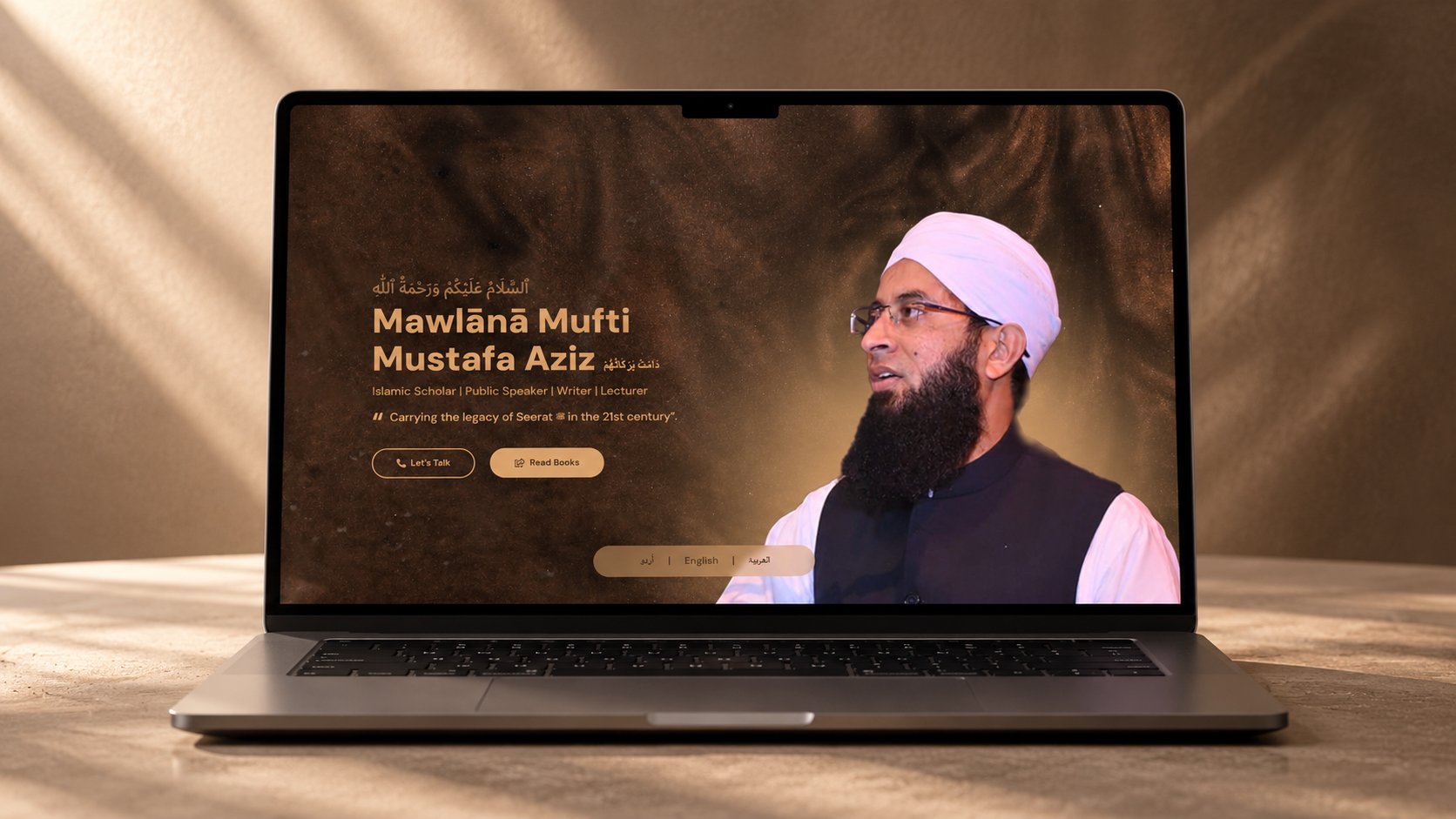 Mufti Mustafa Aziz | Islamic Scholar & Seerah Profile
Website Design · Profile Website
View
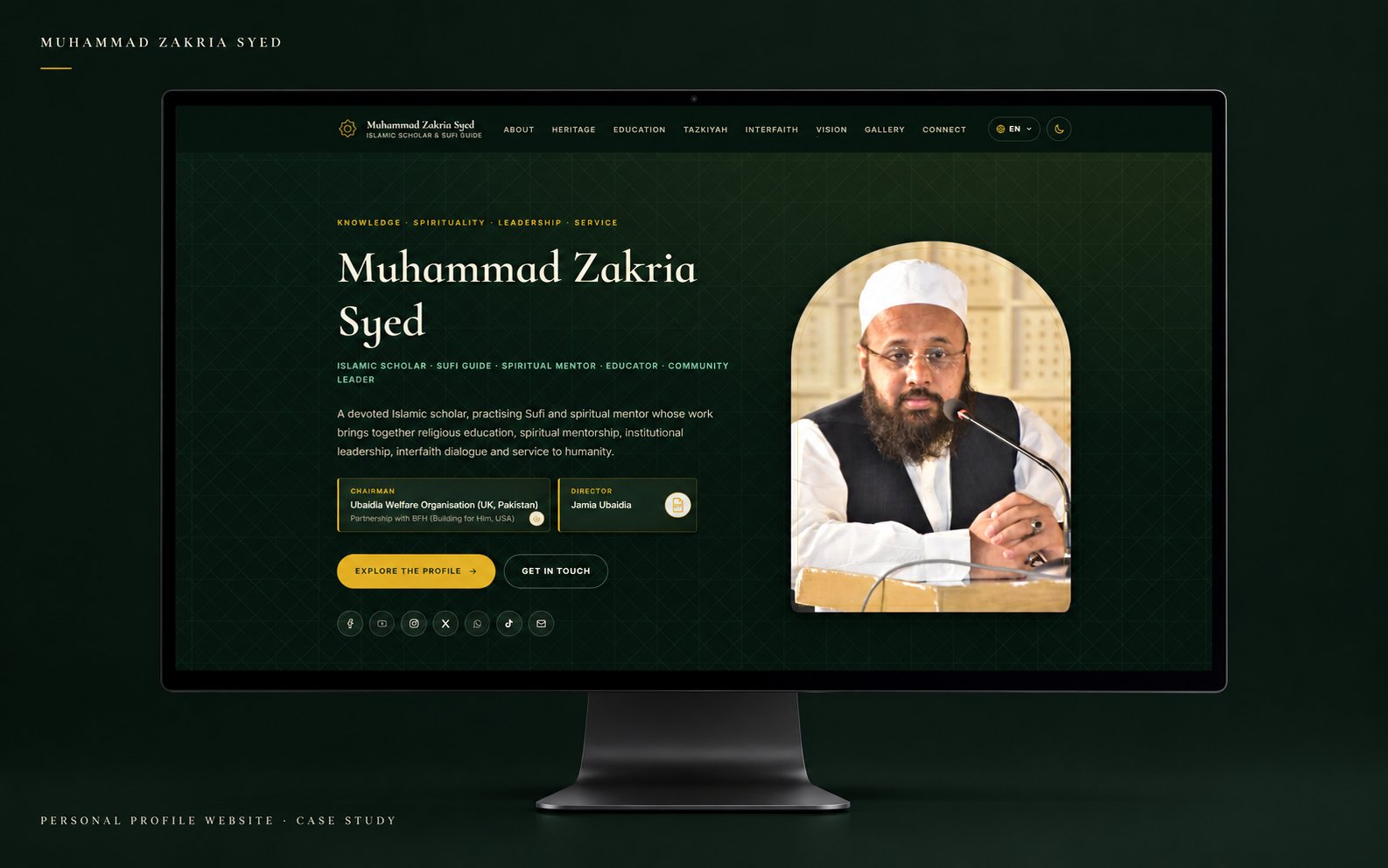 Multilingual Profile Website | Muhammad Zakria Syed
Website Design · Profile Website
View
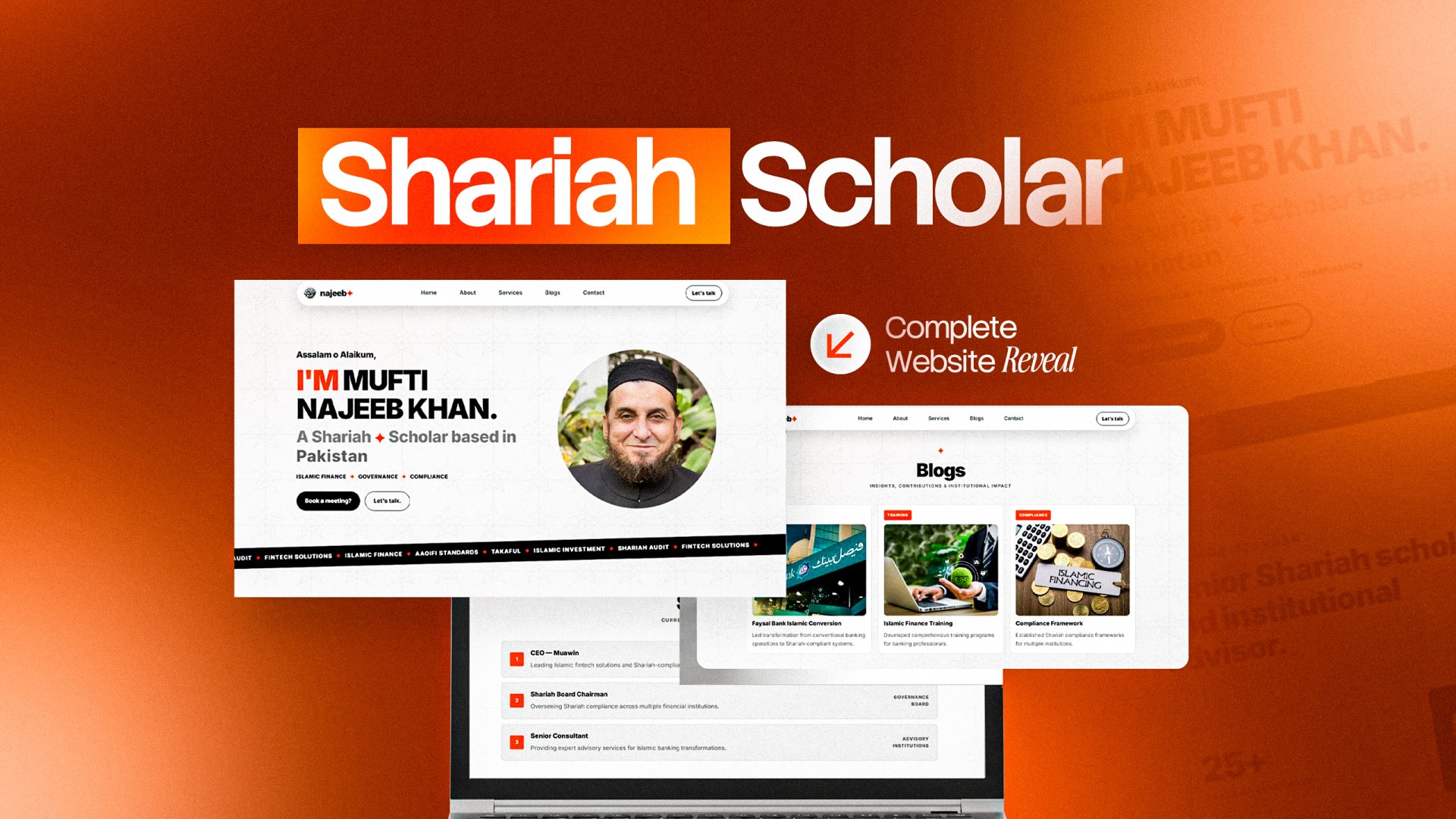 Mufti Najeeb Khan | Islamic Finance & Shariah Profile
Website Design · Profile Website
View
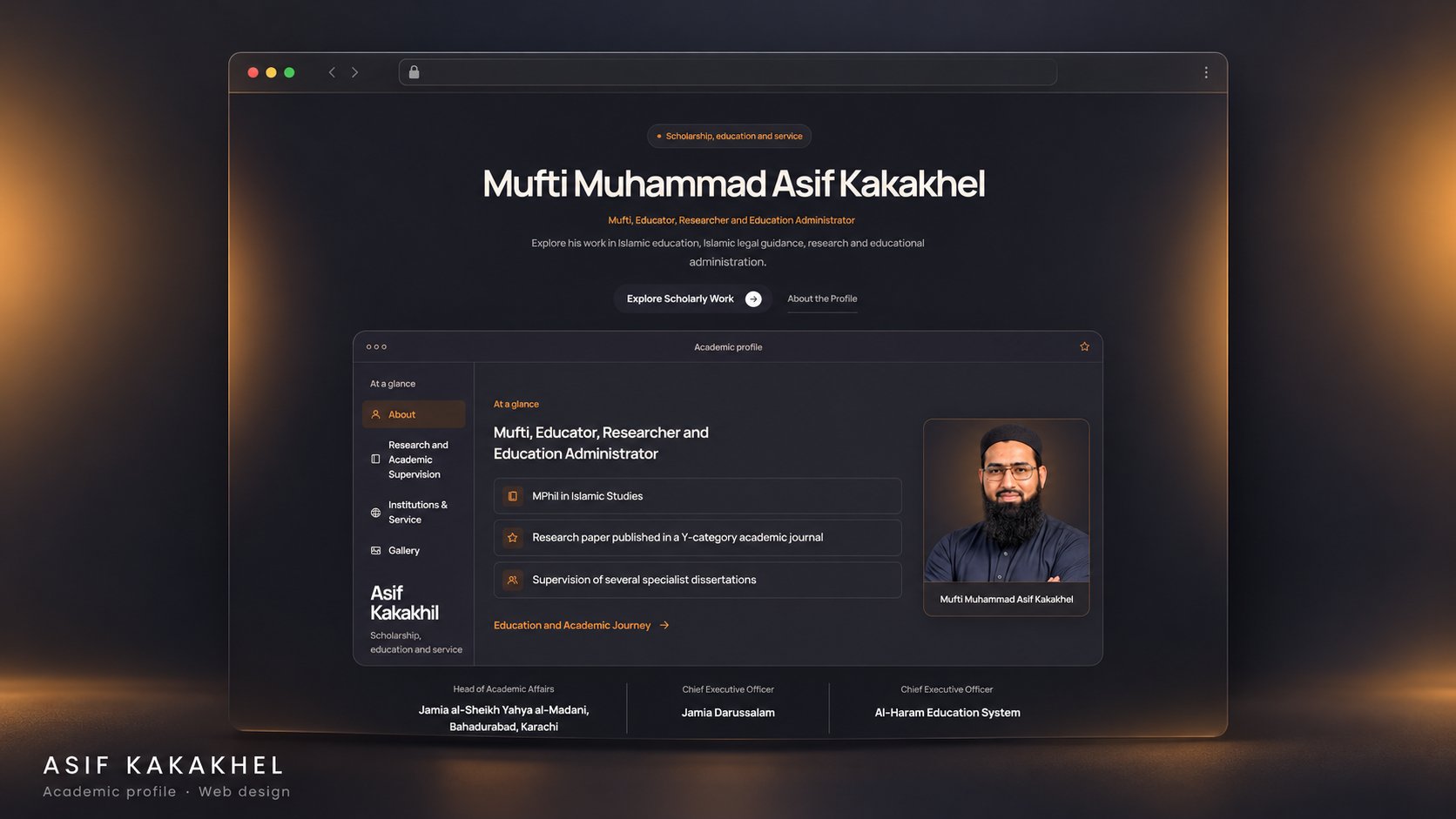 Academic & Professional Profile | Mufti Muhammad Asif Kakakhel
Website Design · Profile Website
View
Scholars deserve their own pages
Senior scholars are often searched more than the institute itself. A scholar profile website brings together biography, ijazat, books, bayanat and contact, and links back to the institute. We have built them for scholars in Karachi, Faisalabad and beyond; our guide on why a respected professional needs a profile website explains what they include.
Portals for admissions and student records
Once the website is live, paperwork can move online: admission forms with document upload, student records, hifz and course progress, and results, all visible only to your staff. These are custom web apps, quoted after mapping how your institute works today.
Design and media that match
- An Arabic calligraphic logo, letterheads, sanad and certificate designs, and book covers.
- Bayan editing: full lectures for YouTube and short captioned clips for social media.
- Event coverage of dastar bandi, khatm-e-Bukhari and annual gatherings.
See the institutes and scholars we have worked with, in Pakistan, the UK and Malaysia, on our madaris and Islamic institutes page, or tell us about your institute.
Frequently asked questions
Which languages should a madrasa website be in?
The languages your students, parents and donors read. Most madaris in Pakistan need Urdu and English; institutes with students or supporters in the Gulf or abroad often add Arabic. Each language should have its own pages, not a machine translation.
Why does Arabic and Urdu typography matter?
Text in the wrong font or direction looks careless to scholars and readers, and Quranic text, names and titles must be exact. A proper right-to-left layout with matching Naskh or Nastaliq fonts makes the site read naturally.
Can the website take admissions from other cities and abroad?
Yes. An online admission form with document upload lets students apply from anywhere, and staff review applications in one place. Hifz and course progress can be added later.
Can we accept donations on the website?
Yes. A donations page can explain each fund, show bank details and accept payment through a gateway your institute has an account with, with receipts for donors.
Can you also edit our bayanat for YouTube?
Yes. We edit full lectures for YouTube and cut short clips with captions for Reels, Shorts and Facebook, so the website and channels stay connected.


